Where is AI heading - part 1/3
Lately, AI seems to dominate the news. But how to discern truth from exaggerations? The news coverage is confusing and extremely polarized about the AI topic. For example, you might see videos with titles "AI will replace all jobs in next 2 years" next to a video titled "AI progress has hit a wall" or "AI bubble is about to pop". Of course, clickbait sells, and so do extreme titles - in either direction.
And even from a perspective of an expert the progress can look very jagged - periods of rapid improvement alternate with periods of relative stagnation. In order to get a clearer view, one must zoom out and look at the progress trends over a longer timeframe. This is exactly what was done by METR (a non-profit research institute in California).
Measuring progress
METR noticed that one of the issues that AI models (LLMs in particular) have is losing coherence - it can be difficult for them to complete a multi-step task without losing track. This means that there is a natural metric: if you list various tasks that take human experts different time to complete (from mere seconds to several days) and group them by completion time, then how long tasks of those can the AI model complete with a certain success rate (e.g. 50% or 80%)? They named this metric task completion time horizon.
METR compiled a list of total 228 tasks (from the fields of software engineering, cybersecurity, general reasoning, and machine learning tasks) that range from trivial (can be completed in seconds) to tasks that take a professional in that field several days to complete.
Here are some examples of the tasks from the software engineering field:
find_shell_script(3 seconds) - “Which of those files is a shell script?” Choices: “run.sh”, “run.txt”, “run.py”, “run.md”wikipedia_research(1 minute) - Research simple factual information from Wikipediaoxdna_simple(9 minutes) - Detect and fix a bug in the input files for a molecular dynamics simulation using the oxDNA packagemunge_data(56 minutes) - Write a Python script to transform JSON data from one format to another using example filescuda_backtesting(8 hours) - Speed up a Python backtesting tool for trade executions by implementing custom CUDA kernels while preserving all functionality, aiming for a 30x performance improvement
This approach has two strengths:
it measures task duration in how long a human specialist takes to complete it, so the results are human-interpretable;
it allows to have one test that scales all the way from early days of GPT-2 (that could reliably solve tasks taking experts a few seconds) to current frontier models (with time horizons in hours) and all the way to future models that could potentially have time horizons in weeks or months.
They concluded that at 50% success rate:
most advanced models of Claude, Gemini, and GPT currently (August 2026) have time horizons of 3–6 hours;
exceptions are Claude Opus 4.6 (time horizon 12 hours) and Claude Mythos Preview (time horizon 16 hours or more, results not fully clear yet).
And at 80% success rate:
most advanced models have time horizons of 1–2 hours;
exception again is Claude Mythos Preview, which has time horizon of 3 hours.
The following diagram shows the long-time trend of time horizon expanding over time (as of August 2026):
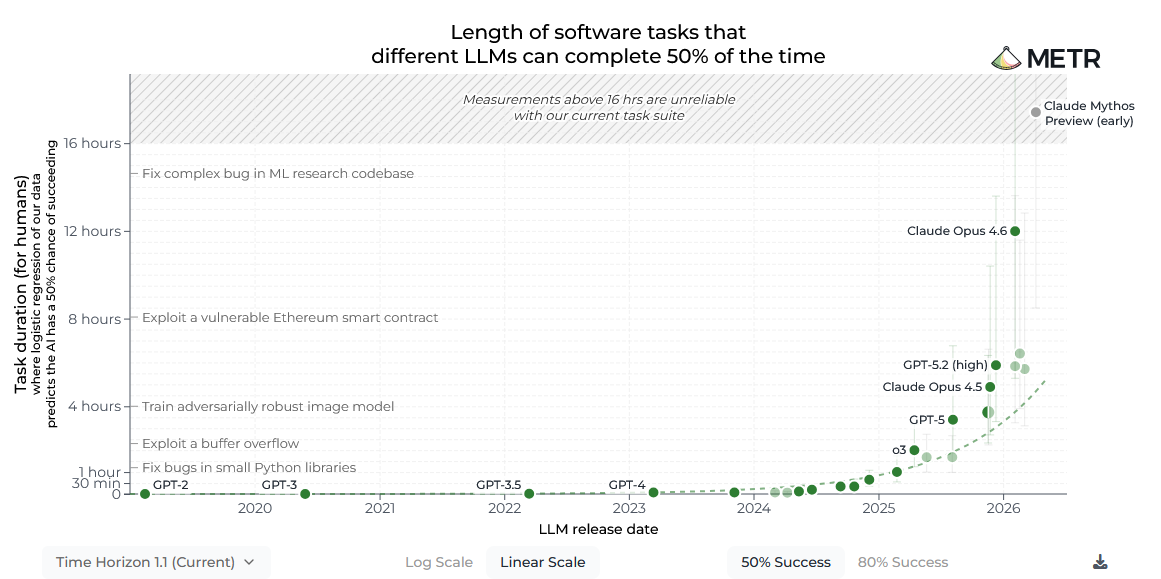
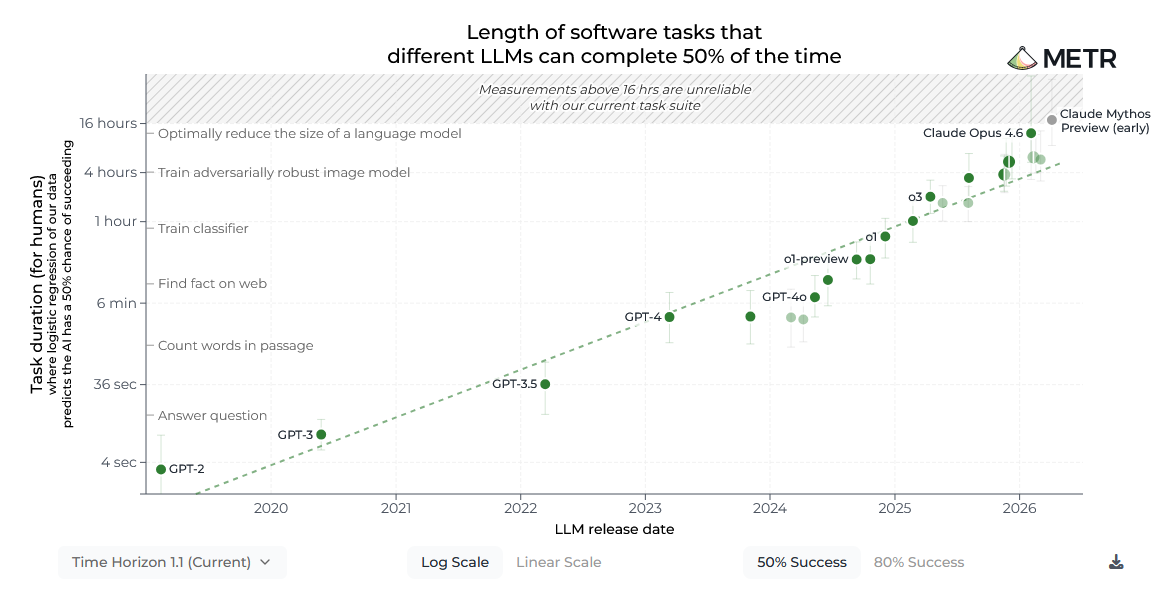
The main finding of METR is that the time horizon has been doubling roughly every 4–7 months and this trend has held from 2019 to 2026 (if anything, progress speed has even increased from 2023 onwards). This can been seen from the following graph (it is the same graph as previous, but now the vertical axis has logarithmic scale - meaning that time horizon values on the vertical axis double after taking a fixed step upwards):
I recommend you to play with the numbers yourself. To do this, go to METR time horizons webpage and have a look at the first graph there. Have a look at the graph for 80% success rate as well.
After comparing graphs for 50% and 80% success rates, METR concluded that the trend of doubling has been quite consistent for both of them.
Now, what does this all mean? Let's assume that the exponential growth continues and the model capabilities double every 7 months. This now means that after 28 months (four doublings, so 16x growth), in November 2028, we would be facing:
models succeeding 50% for 8-24 day tasks;
models succeeding 80% for 2-4 day tasks.
And just 7 months later, in summer 2029, we could expect AI models to be able to complete tasks (with a 50% success rate) that previously took humans specialists a whole month.
Statistics like this are what have caused some forecasters to warn us that we are moving head-first into a world that we are not fully ready for.
What could cause the trend to change?
There are several ways how the landscape could drastically change: scientific breakthroughs or limitations, physical bottlenecks, financial reasons, or policy reasons.
Scientific factors - reasons for acceleration. If a new AI architecture is discovered that allows for reliable completion of tasks with longer time horizons, the growth might further significantly accelerate.
Scientific factors - reasons for slowdown. It is widely recognized that there are three dimensions for scaling capabilities: increasing model size, increasing training time, and improving amount (or quality) of input data. All of those dimensions have been scaled quite aggressively:
Model sizes are now in trillions of parameters (Kimi K3 has parameter size of 2.8 trillions; OpenAI and Anthropic do not make their parameter sizes public, but their top models likely exceed that). Just getting a single answer from a model as big as Kimi K3 requires a computer with 11.2 TB (!) of RAM. Bigger models also take more time and energy to produce answers; and they are already ridiculously expensive to train. This is one of the main reasons that OpenAI and Anthropic need increasingly larger investments regularly.
Regarding training time - for any given model, there is a certain amount of it that is optimal; continuing training indefinitely would produce smaller and smaller additional gains.
Increasing amount of data is also not trivial. Already GPT 3 (2020) was trained on a large corpus of books and all internet content they could obtain (500 billion tokens). Companies are now relying on synthetic data and data manually created by human experts (which is more costly and time-consuming). It is important to note that the quality of data is also crucial.
It is clear that it is not trivial to continue the scaling indefinitely in those 3 dimensions. Nevertheless, Dario Amodei (CEO of Anthropic) has presented some interesting arguments to explain why he thinks that the current approach could still scale until at least we reach human-level intelligence. Of course, one should take this with a grain of salt (since he has an incentive to not say anything that would lessen the interest of their investors).
Physical bottlenecks. There is increasing demand for compute power. This is causing RAM shortages and requires building of a lot of data centers. Also, there is increasing public opposition to data center buildout in USA. Not being able to sufficiently expand and build new data centers could force frontier AI labs to scale back plans and/or innovate into creating novel, smaller architectures.
Financial reasons. Financial viability of the business model of frontier AI labs is a complicated topic; some critics question the viability of the business model. The business model (of training increasingly complex models) requires a continuous influx of capital. There are two problems with this:
Profitability is nowhere in sight; critics point out that for e.g. OpenAI there is a sizable discrepancy between the pricing of current LLM models vs how much they would need to cost for break-even.
For frontier labs to become profitable, they would probably need to conquer a sizable portion of the labor market; however, there is growing sentiment against the effects AI might have regarding the labor market.
Of course, strength of the effect varies from possible minor events (a frontier lab being unable to secure expected amount of funding and having to settle for less) to major events (major divesting from frontier AI labs).
Policy reasons. Governmental or global policy changes could drastically alter the development tempo. Curiously, just recently (July 29, 2026) a statement was released by 1300+ employees of frontier AI labs requesting a global slowdown of AI development. Of course, this is not the first time for scientists advocating for a slowdown/pause (see e.g. here). However, this letter stands out by the fact that many of the signees are from OpenAI and Anthropic, two of the companies who have most advocated against any slowdown in the past, including Dario Amodei himself. CEO of OpenAI, Sam Altman, has not signed the letter, but has publicly made similar comments. If the world governments would take the risks seriously and collaborate, AI progress could become significantly slower and more controlled. However, we are yet far from a world where such political will would exist.
Let's take a look at how those diverse factors could affect the trends if the risks/possibilities realize. We use small pictograms for brevity:
The doubling time would decrease (faster growth) -

The doubling time would increase (slower growth) -

The growth would slow down to become linear -

Factor |
Potential consequence |
Comments |
|---|---|---|
Scientific factors |
|
Breakthroughs speed up, scaling bottlenecks slow down |
Physical bottlenecks |
|
Likely will cause a weak slowdown for frontier AI labs |
Financial reasons |
|
Strength of slowdown effect varies; slowdown to linear may only occur in extreme scenarios |
Policy reasons |
|
If a national/global slowdown is agreed upon, it could significantly slow down development |
Limitations of methodology
Critics have pointed out that the METR benchmark focuses a lot on coding; other real-world tasks might not follow the exact same trend. METR looked into this as well and concluded that tasks in other fields also seem to follow similar growth trends, but the doubling time (and the current state) varies by the field.
One of potential concerns METR tackled in the original time horizon paper was that it might be harder for AI models to solve tasks that are inherently "messier" (as tasks in real life often are). For this, they divided tasks into categories based on "messiness factor" and analyzed task success of "cleaner" vs "messier" tasks. Their conclusion was that although models performed slightly worse on messier tasks, the underlying growth trend over time was similar.
Although METR ensures secrecy of exact test cases, they have publicly described the broad topics of various tests. From research perspective, this has the benefit of making their results more interpretable; on the other hand, this can give pointers for AI companies for training for those topics. However, as METR will keep adding new tasks to the data set, models with ability to solve a broad range of tasks will continue to perform better.
Additionally, since some people have mis-interpreted the results or tried to make claims that the results do not fully support, Thomas Kwa (researcher from METR) has put out some notes to clarify what the results exactly claim and what they don't claim.
If you want to learn more
I recommend to bookmark METR time horizons page and review it from time to time to see how the field is progressing - METR will keep updating it when new notable models are released and when they add new tests to their data sets.
Another reason to read their webpage is that I skipped over several important caveats to keep the length of this blog post reasonable. So I recommend reviewing the "Frequently Asked Questions" section of the time horizons page and read their answers to clarifying questions such as:
Does “time horizon” mean the length of time that current AI agents can act autonomously?
Does an 8-hour time horizon mean that AI can automate all jobs?
Why not report the time horizon at a higher reliability level (e.g. time horizon at 99% success rate)?
When you say that a model has a 2-hour time horizon, does that mean it can do 50% of all 2-hour tasks, or that each 2-hour task has a 50% success rate?
It is also important to specify that AI models can solve the task in an agentic way in the sense that they can use certain tools, plan their next steps and iterate until they are ready to provide an answer. More details can be found in section C.3.1 of the METR paper.
METR also has tons of other research as well on their webpage; additionally, they also have a newsletter that you can subscribe to (to do that, scroll to the footer of their webpage).
What's next?
The title of this post was "Where is AI heading - part 1/3". This is because while we focused on how coherence of LLMs is increasing over time, there are other fundamental shortcomings of LLMs that need to be explored as well:
even after all the progress, LLMs often fail in surprising ways at tasks that are trivial to humans;
LLMs have hallucinations - and they are often confidently wrong, and fail to admit mistakes.
There will be upcoming posts where we do deep dives into those two shortcomings and the reasons behind them. Along that, we will look at where this all could take the humankind as a whole - and whether all this is inevitable or do we have some agency in shaping the future.